Tips for slowing down fungicide resistance in fruits
October 31, 2025

Editors note: This article was originally published in 2013 and was updated with new information in October 2025.
Fruit rots and foliar pathogens can ruin an otherwise marketable crop so, keeping them at bay – both now and in the future is critical to long- term success. By now, you are familiar with the need to rotate tools for long-term control, as we only have so many tools to manage tough diseases like Botrytis, powdery mildew, and anthracnose (Colletotrichum spp.). Before another season begins, it is always good to refresh your memory on the tools that exist and how to use them to maintain their effectiveness as long as possible.
Three things you need to know:
Understand which products are available to you to use, which diseases they suppress or control, and how they are classified by mode of action.
- Know your diseases: Disease management is more than just fungicides. Get to know the primary diseases in your crops and understand their biology and what conditions they fester in to better implement all available management practices.
- Know your region: Consider the history of fungicide resistance in your growing region, and when available, participate in local monitoring programs that assess current fungicide sensitivity.
- Know your tools: The Fungicide Resistance Action Committee (FRAC) has a great explanation of fungicide classification and modes of action groups (FRAC groups). Watch this short clip about codes and labelling:
Know your diseases
Not sure what you could face this season or perhaps there is a new crop on farm? The
Ontario CropIPM website is a great place to start learning the basic diseases by crop so you can be familiar with formidable foes, and make a plan, before the season starts.
Get to know which Syngenta tools contain which FRAC groups:
There are many potent specialty tools in the toolbox within the Groups 3, 7, 9 and 11, as you can see below. After considering these specialty products, a great option to really change things up is to use Bravo ZNC or Captan L which are multi-site fungicides (Group M) that work at multiple points on the pathogen and help to reduce the risk of resistance. Check out the
Bravo ZNC and
Captan L labels to see if these are options for your crop.
|  |  |  |  |
|---|
| FRAC code | 9 | 12 | 7 | 12 | 3 | 9 | 29** |
| Grapes | Botrytis bunch rot | Botrytis grey mould, powdery mildew | Powdery mildew, Botrytis bunch rot, black rot, Alternaria rot, foliar anthracnose | Dead arm, Botrytis grey mould, anthracnose* |
| Strawberries | Grey mould, powdery mildew*, anthracnose | Grey mould, anthracnose | Botrytis grey mould, anthracnose** | Not registered |
| Blueberries (highbush) | Anthracnose, Botrytis fruit rot, mummyberry | Botrytis fruit rot | Monilinia blight, mummyberry, rust*, anthracnose, Alternaria leaf spot | Botrytis grey mould, mummyberry*, Phomopsis fruit rot*, fruit anthracnose* |
| Blueberries (lowbush) | Anthracnose, Botrytis fruit rot, mummyberry, sclerotinia berry drop* | Botrytis fruit rot, anthracnose | Botrytis grey mould, mummyberry*, Phomopsis fruit rot*, fruit anthracnose*, Valdensinia* |
*Suppression
**Wine grapes only
Know the rules:
Next, review guidelines for each mode of action group. To simplify these guidelines, below you will find a list of key considerations that will help, regardless of disease and mode of action:
- Ensure preventative use patterns of products. An ounce of prevention is worth a pound of cure.
- Use multiple modes of action that work on the disease, called mixtures. Remember that mixtures can serve two purposes – to broaden spectrum, or to serve as a resistance management tool. An effective mix partner for resistance management provides effective control on its own – if the mix partner isn’t effective on the target disease, treat the application as a solo.
- Rotation of chemistry, or alternation of chemistry.
- Using integrated pest management. What are some of the cultural practices that you could use to lower disease pressure?
For some medium and high-risk pathogens, there are more specific guidelines about alternation, mixing, and the total number of applications in a season. Here’s an example for Botrytis:
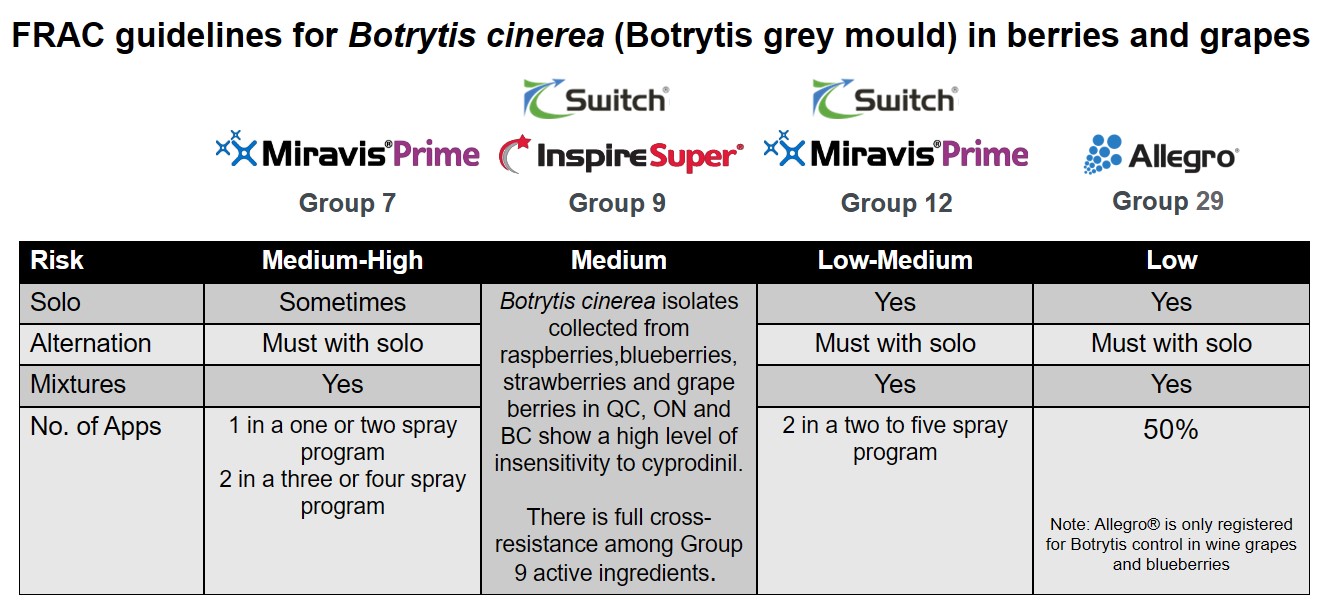
Sources:
a) Internal Syngenta fungicide sensitivity trial (mycelial growth assay), Canada, n = 1 (19 isolates). Isolates collected in 2020-2022 from blueberries and raspberries in British Columbia and provided by Dr. Rishi Burlakoti (AAFC)
b) Internal Syngenta fungicide sensitivity trial (mycelial growth assay), Canada, n = 1 (33 isolates). Isolates collected in 2022-2023 from grapes in Quebec (4) and Ontario (17) by internal staff. Nine (9) grape isolates from Ontario and collected in 2022 were provided by OMAFRA. Isolates from British Columbia (3) were provided by Dr. José Ramón Úrbez Torres (AAFC) and collected prior to 2003.
c) Source: Internal Syngenta fungicide sensitivity Botrytis trial (mycelial growth assay), Canada, n = 1 (39 isolates). Isolates collected in 2022-2023 from strawberries in Nova Scotia (17), Quebec (7), and Ontario (15) by internal and external collaborators. Internal Syngenta fungicide sensitivity Colletotrichum trial (mycelial growth assay), Canada, n = 1 (57 isolates). Isolates collected in 2022-2023 from strawberries in Nova Scotia (17), Quebec (28), and Ontario (12) by internal and external collaborators.
Putting it all together
Using what you know, map out a management plan for the season. Remember to also consider pre-harvest intervals, restricted entry intervals, maximum applications per season on the product label, and other label restrictions, which vary crop by crop.
Reach out to your Syngenta rep or retail partner if you’d like advice on building a Botrytis program with resistance management top of mind.
Does this seem overwhelming? Reach out to your Syngenta rep or retail partner if you’d like advice on building a crop protection program with resistance management top of mind.
For more information contact our Customer Interaction Centre at 1-87-SYNGENTA (1-877-964-3682).
Please check with your exporter when using any Syngenta product on crop destined for use outside of Canada. For a complete list of residue limits by country, visit the
Foodchain ID Regulatory Limit website by BCGlobal. Should you need additional information on export market MRLs, please consult with Syngenta to receive the most up-to-date information.
For more information including articles, resources and videos on resistance management, check out
Manage Resistance Now. This is a collaborative effort of industry, academia and government experts, brought together by CropLife Canada, to raise awareness and promote the adoption of strategies to manage weed, insect and disease resistance.
Always read and follow label directions. Aprovia
®, Bravo
®, Miravis
®, Quadris Top
®, Switch
®, Inspire Super
® and the Syngenta logo are trademarks of a Syngenta Group Company. Allegro
® is a trademark of ISK Biosciences Corporation.
